Since September 11, 2001 I've had the opportunity to visit New York City numerous times and have always made it a point to walk around Ground Zero to check on the progress in rebuilding the site of so much suffering and pain, but also so much hope and optimism that America can rebuild from the ashes. I've also visited other 9/11 Memorial sites, particularly in the Los Angeles area. Most recently, I was in Israel where I took photos of memorials to victims of terrorism there. Here is one person's photographic perspective on 9/11 and tribute to victims of terrorism around the world.
GROUND ZERO, 2004
GROUND ZERO, 2008
GROUND ZERO, 2010
NEWSEUM, WASHINGTON DC, 2008
9/11 MEMORIAL FOUNTAIN, FIRE STATION 88, SHERMAN OAKS, CALIFORNIA, 2005
The Westside Subway Extension is going to happen. Will it be built in ten or thirty years? That depends on the political will in Washington and the lobbying efforts of Los Angeles leaders in City Hall. But whether the Purple Line train reaches the VA Hospital west of the 405 Freeway in a decade doesn't matter if you want to get to the beach today via mass transit.
When I visited L.A. this summer I wanted to see friends on the Third Street Promenade in Santa Monica without a car. My Blue Line train arrived in downtown Los Angeles from downtown Long Beach and I switched trains at 7th St./Metro Center to the Purple Line subway that took me to the end of the line at Wilshire/Western in the Koreatown neighborhood.
At that point you can transfer to either the Metro Rapid 720 bus or the 20 local bus for a crowded, bumpy ride down pothole-riddled Wilshire Boulevard. The bus takes you through Koreatown, Miracle Mile, Beverly Hills, Westwood, Brentwood and Santa Monica before ending near the Santa Monica Pier. It is obvious from a ride on the 720 that it is no substitute for heavy rail. The bus is jam packed at nearly all hours and until L.A. invests in repaving Wilshire through Koreatown and Miracle Mile, it is incredibly uncomfortable bouncing around like rag dolls.
But the bus will get you to the beach eventually and Wilshire smooths out through Beverly Hills and Santa Monica. There is also a newly repaved stretch through Westwood. Additionally, the L.A. City Council recently approved bus-only lanes along Wilshire, which will save 11 minutes of travel time on a one hour trip. Now whether the bus driver is erratic or calm is another story. Getting a good or a bad bus driver is the luck of the draw.
In Santa Monica we walked down the Third Street Promenade where we saw talented street entertainers, ate fresh organic fruit at the Farmers Market and toured the new Santa Monica Place, which was recently converted from the Frank Gehry-designed indoor shopping center built in 1980 to an outdoor mall perfect for the year-round sunny Southern California climate.
Here are more photos of the Purple Line subway and Metro Rapid 720 bus:
And here is video of the Metro Purple Line subway arriving at 7th St./Metro Center:
I lived in Long Beach for two years so it was a bit of a homecoming for me this summer when my friend picked me up at the Anaheim Amtrak station across from Angel Stadium. We drove to the LBC and straight to a park near Long Beach State University where we were treated to classic hits from the Long Beach Municipal Band. There were lots of families and couples spread out on the lawn making picnics and listening to good music.
One reason I like Long Beach is because it is the fifth largest city in California but still manages to maintain a small-town, family-oriented atmosphere. That small town spirit was alive and well that day at the park with the Long Beach Municipal Band.
The next day I rode the L.A. Metro Blue Line light rail train from downtown Long Beach to downtown Los Angeles. The line is the oldest ( opened in 1990) and busiest (26.6 million boardings per year) in the system and has become notorious for its high number of incidents involving pedestrian and motorist fatalities -- to this date over 100 pedestrians and motorists have been killed and there have been more than 800 accidents at level crossings.
The Blue Line passes through some of L.A.'s poorest and most crime-infested neighborhoods in South L.A., including Watts and Compton.
My experience riding the line however has been incident-free and positive. And I encourage anyone visiting L.A. to not be afraid to ride the Blue Line during the day (night might be a bit sketchy). Yes, you will see stereotypical gang members and mentally unstable people, but you will also see Hispanic, African-American, Caucasian and Asian families, children on their way to school, elderly people on their way to the doctor and men and women on their way to work. In other words, everyday people living their lives like anywhere else.
Los Angeles is much more than Hollywood, Beverly Hills and Santa Monica. It is an educational experience to ride public transit through the working class black and immigrant neighborhoods of the City of Angels.
Photos of my ride from downtown Long Beach to downtown Los Angeles:
And here is video riding the Blue Line train from downtown Long Beach to downtown Los Angeles via Compton:
Solana Beach is home to one of the finest little train stations in all of America. The station was designed by architect Rob Wellington Quigley, and was built in 1994 to replace the depot in Del Mar, California. The main terminal is a real gem with a sleek, modern design and the platform is sunken into the earth, creating a surreal environment in which you feel as if you are underground but you are outside, just lower than street level.
The station is served by Amtrak's Pacific Surfliner trains between San Diego and Santa Barbara via Los Angeles and Orange County; and Coaster commuter trains between North San Diego County and downtown San Diego.
Here are photos of the station:
And here is video of a Coaster commuter train departing the station, heading south towards downtown San Diego:
The ride north from Solana Beach to Anaheim on Amtrak's Pacific Surfliner provides passengers with some of the most spectacular scenery in the world. In North San Diego County and South Orange County the train tracks are placed within yards of the Pacific Ocean. The ocean and beach views are breathtaking. At times you feel as though you are riding on the water you are so close to the Pacific. In my view there is perhaps no better way to experience the beauty of Southern California then taking the train through North San Diego County and South Orange County before the tracks veer inwards towards Anaheim and eventually Union Station in downtown L.A.
Here is a video montage of the part of my train trip with the best views of the beaches and Pacific Ocean. The video starts just around Oceanside and ends at San Clemente.
There are so many reasons to fall in love with San Diego, California. The perfect climate. The pristine beaches and ancient bluffs. The sublime sunsets over the mighty Pacific Ocean. Torrey Pines State Reserve. The Gaslamp Quarter. Balboa Park. But it is the palm trees that always get to me. Even though most of them were imported in the 1920s and 30s, for me Southern California is defined by the sun drenched palm tree swaying against the backdrop of a powder blue sky.
Change is the only constant in life and no people embrace change more than Californians. When you live with earthquakes, mudslides and wildfires you learn to live in the moment and meditate on the temporary nature of all things.
There was change on my visit to San Diego. The Flower Hill Mall movie theater in Del Mar is shuttering after giving North County San Diegans thirty years (ten as an Ultrastar chain) of art house films and the latest blockbusters. It is being replaced by a Whole Foods Market.
More change as the Del Mar Highlands Town Center is undergoing a major renovation and expansion. The UltraStar Cinemas there will be adding new auditoriums and there will be a new courtyard and fountain, along with new shops and restaurants. The expansion will replace the auditoriums lost from the closing of the Flower Hill theater.
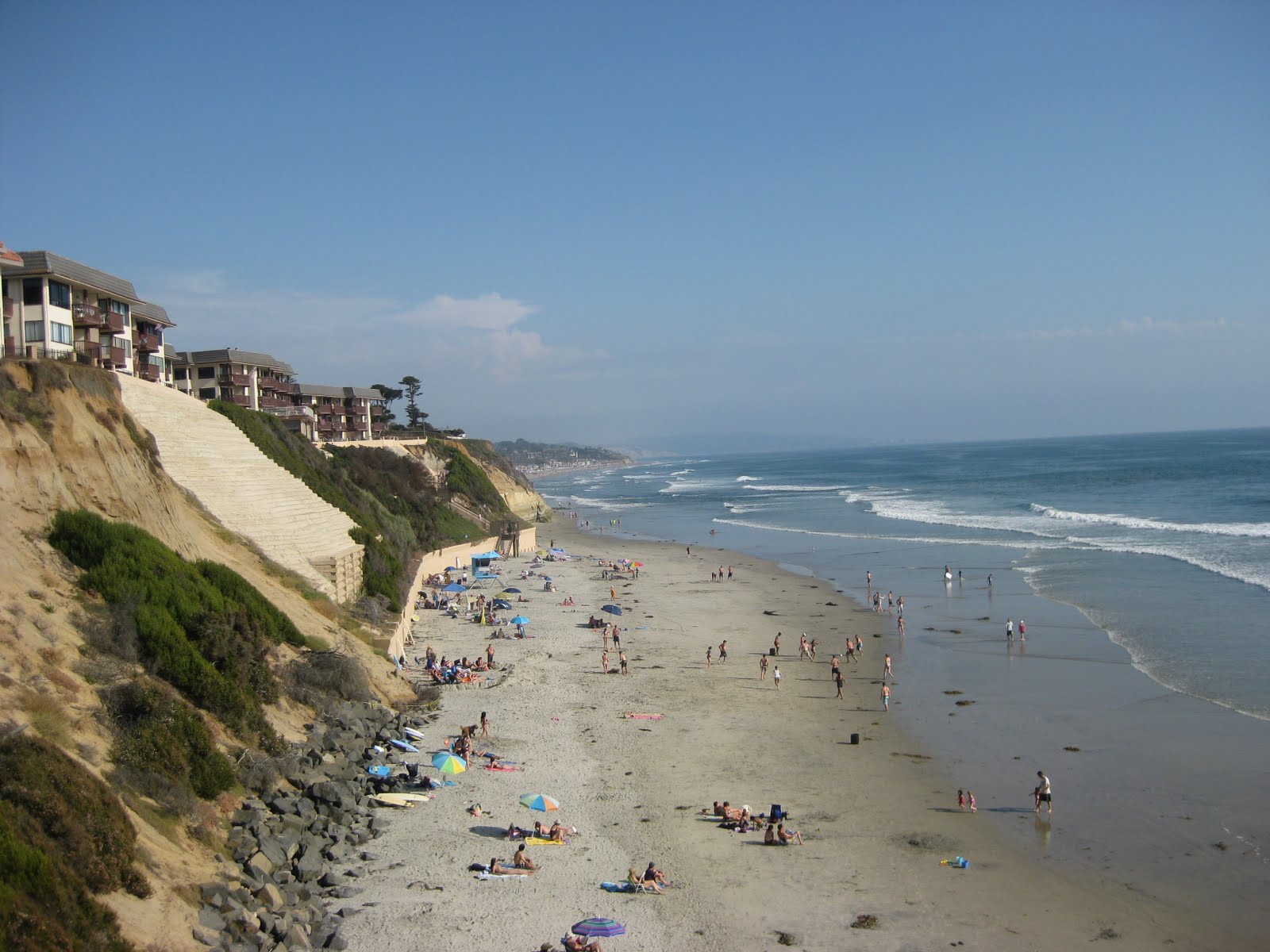
What better way to spend the Fourth of July then at the sun-soaked SoCal beach. In this case, a walk on the sand at Del Mar Shores in Solana Beach. Enjoy the pictures.
I snapped this picture from my camera phone as we passed near the massive wildfire that had at one point threatened the Los Alamos National Laboratory -- one of the country's biggest nuclear research facilities and home to an old hazardous waste site. The fire was only 70 feet from the facility before firefighters pushed it back.
Thankfully the lab was spared and the fire is now 40 percent contained. But the largest wild-lands blaze in New Mexico history sadly still threatens a sacred Pueblo Indian mountain, although the weather is helping stave it off for now.
Props to the United Airlines pilot on the flight from Washington Dulles to San Diego Lindbergh Field for pointing this out to the passengers.
For much of its history, Washington Dulles International Airport was derided by some travelers for its long distance from downtown D.C. and its clunky and inefficient mobile lounges. It just took too long to drive the 26 miles from the center of Washington, wait in long security lines, and then wait again for the crowded mobile lounge to slowly makes its way to the midfield terminal.
But Dulles is changing for the better by spending billions on improvements in and around the airport. And I have to say my experience flying out of there two days ago on United Airlines to San Diego was pure pleasure.
For one, the mid-Friday afternoon drive along the Dulles Access Road was virtually traffic free. Along the way I could see the rapid progress being made on the Metro Silver Line extension that will eventually make its way past Dulles in 2016. The first phase to Tysons Corner and ending at Wiehle Avenue should be done by 2013. There is controversy over the cost of the project and whether there should be an underground station or aerial station at Dulles. But the bigger picture is that above or below ground, Metro is coming to Dulles and that means hopping aboard a train downtown and arriving at Dulles. Easy access to public transportation is one of the factors that makes an airport world class. And Dulles is getting just that.
Once at the airport, the new security screening mezzanine in the main terminal is the most hassle free and least clogged up post-9/11 security checkpoint I've experienced at any airport in the United States. The space is open with lots of light, there are ample videos and people guiding passengers in the proper steps to take before going through the checkpoint. It is the first time I can actually say I've enjoyed passing through an airport security checkpoint. And that is saying a lot in this day and age. So kudos to Dulles for making airport security less of a degrading experience.
But the best new feature of Dulles is the AeroTrain people mover system that replaces those awkward mobile lounges and whisks passengers from the main terminal to Gates A, B and C. Here is video I shot from the front of the AeroTrain car a couple of days ago.
In summary, while Dulles still has a lot of work to do to achieve world class status, including the final decision on where the Metro station will be placed, the airport deserves lots of praise for its progress in making the flying experience more humane and sensible.
Soon Washington Dulles International Airport will fully live up to the ideals of its architect Eero Saarinen when he espoused that "the purpose of architecture is to shelter and enhance man's life on earth and to fulfill his belief in the nobility of his existence."